The artificial intelligence landscape moves at a rate that regularly renders yesterday’s breakthroughs today’s baseline. Yet, every so often, a release lands that shifts the entire paradigm of how software gets built, how enterprises automate workflows, and how humans interact with machine intelligence. Anthropic’s release of Claude Sonnet 5 is precisely that kind of release.
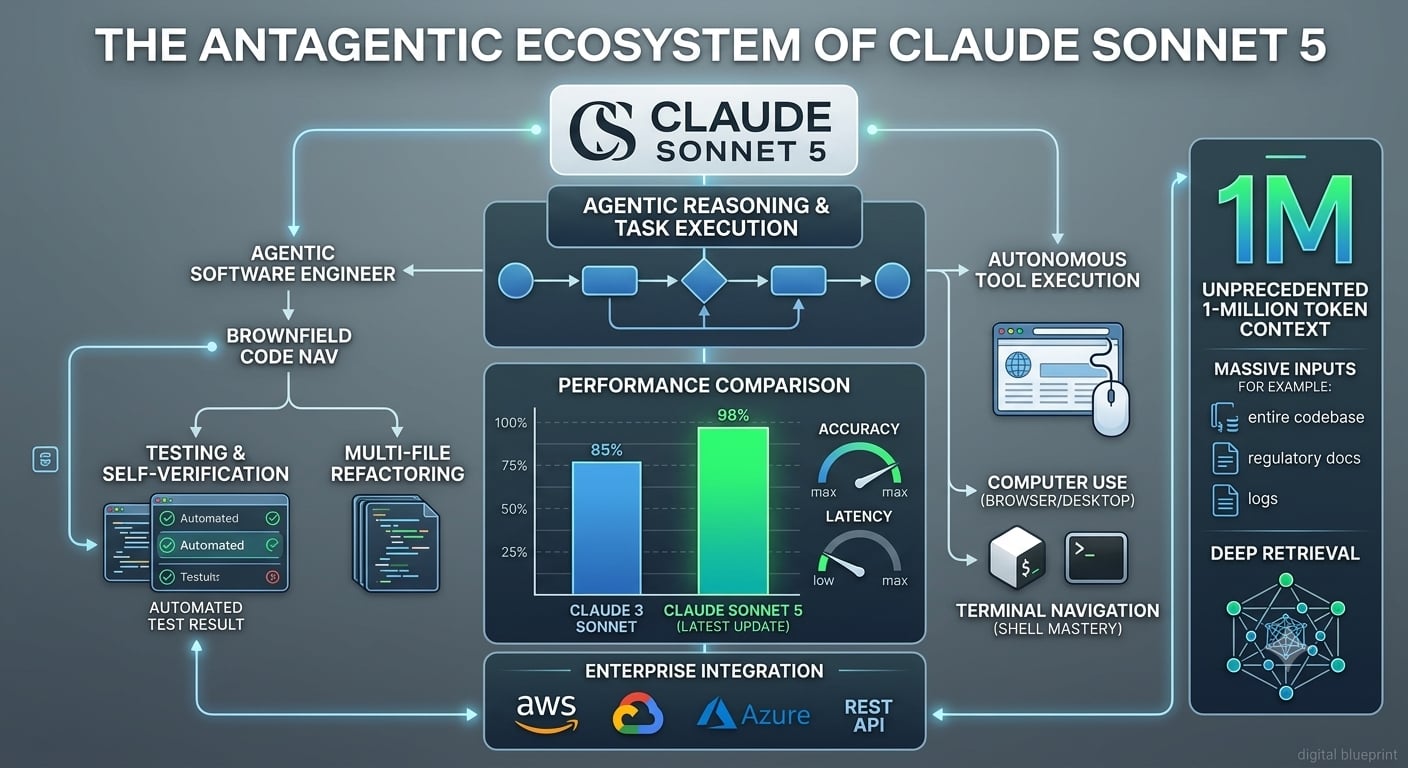
Historically, AI development sat squarely in the realm of autocomplete, text generation, and passive assistance. You typed a prompt, the model generated a response, and you manually evaluated the output. Claude Sonnet 5 dismantles this old paradigm entirely. It does not just assist; it operates, executes, debugs, and verifies autonomously. By combining a standard 1,000,000-token context window with native computer execution tools, adaptive multi-tier thinking, and unprecedented brownfield coding capabilities, Sonnet 5 establishes itself as the quintessential engine for the modern developer ecosystem.
1. The Evolution: From Passive Copilots to Autonomous Software Engineers
For the past few years, artificial intelligence tools in software development functioned like hyper-literate copilots. They could complete a function, write a boilerplate unit test, or summarize a documentation page. However, the moment a task required multi-file context, complex architectural trade-offs, or hands-on terminal navigation, human developers had to take the wheel.
Claude Sonnet 5 fundamentally redefines this dynamic. Rather than acting as a static text generator, Sonnet 5 is built from the ground up to operate as an **agentic software engineer**. When given an instruction—such as "fix the performance bottleneck in our database integration module"—the model does not merely spit out a code block. Instead, it systematically breaks down the execution lifecycle:
- Environment Exploration: Inspects the file structure, reads relevant configuration files, and analyzes recent commit logs.
- Diagnostic Testing: Writes isolated, failing unit and integration tests specifically targeted at capturing the reported bottleneck.
- Code Refactoring: Implements code modifications across multiple files and dependent modules.
- Self-Verification: Runs the test suite in a local containerized environment, captures logs, monitors memory consumption, and iterates on its own code until all tests pass cleanly.
This paradigm shift from simple generation to autonomous verification means developers spend significantly less time babysitting AI outputs and more time defining high-level system architecture and product logic.
2. Core Architectural & Technical Breakthroughs
Behind Sonnet 5’s operational capabilities sits a series of major structural, algorithmic, and alignment innovations engineered by Anthropic.
A Standard 1-Million Token Context Engine
Processing long contexts is no longer an experimental opt-in setting or a premium feature reserved for specialized enterprise tiers. Claude Sonnet 5 provides a standard 1,000,000-token context window out of the box, backed by a extended maximum output limit of up to 128,000 tokens.
More importantly, Anthropic has dramatically improved "needle in a haystack" retrieval accuracy. In prior generations, feeding millions of tokens into a context window frequently led to mid-document information loss or degraded reasoning over complex long-range dependencies. Sonnet 5 maintains near-perfect retrieval accuracy across the entirety of its context window, making it capable of ingesting entire enterprise code repositories, thousands of pages of regulatory documentation, or months of detailed application telemetry in a single request.
Adaptive Internal Reasoning & Dynamic Thinking
One of the persistent challenges in deployment has been balancing latency with depth of thought. Simple queries (e.g., reformatting a JSON schema) do not require multi-step internal reflection, whereas complex algorithmic bugs require extensive reasoning before a single line of output is produced.
Claude Sonnet 5 solves this with **Adaptive Thinking**. Rather than relying on rigid manual prompt engineering or fixed chain-of-thought toggles, the model dynamically measures task complexity at the point of ingestion. For simple tasks, it responds instantaneously. For deeply intricate logical problems, Sonnet 5 allocates internal hidden reasoning steps to systematically map out edge cases, verify math, and simulate execution paths before generating its final output.
The High-Efficiency Tokenizer
Sonnet 5 ships with an entirely reworked tokenizer engine tailored specifically for developers and data scientists. By significantly optimizing tokenization efficiency for non-English languages, structured JSON schemas, YAML configurations, and popular code syntaxes (TypeScript, Python, Rust, Go), the model achieves up to a 20% reduction in token consumption for typical developer workloads. This directly reduces latency and lowers API costs for high-throughput enterprise pipelines.
3. Deep Dive into Agentic Capabilities: Computer Use & Web Navigation
Code writing is only half of the modern developer's job. To truly automate technical workflows, an AI system must interact with the software environment in the exact same manner a human engineer does: using browsers, running terminal commands, navigating cloud consoles, and inspecting visual UI elements.
With Sonnet 5, Anthropic introduces the upgraded computer_toolset_20260801 standard. This framework equips the model with high-precision visual perception and system execution features:
- Pixel-Perfect Computer Interaction: Sonnet 5 can interpret screen capture inputs, map out UI elements with pinpoint precision, and execute mouse clicks, drags, keystrokes, and multi-step navigation across any desktop software.
- Interactive Web Automation: Beyond static HTML scraping, Sonnet 5 natively navigates dynamic web apps, manages multi-factor authentication flows, verifies frontend UI components across multiple screen breakpoints, and fills out multi-step forms seamlessly.
- Terminal & Shell Mastery: The model writes, executes, and monitors bash/zsh scripts inside isolated sandboxes, analyzing standard error logs, handling background processes, and troubleshooting dependency conflicts in real time.
Imagine tasking an AI with testing a newly deployed feature. Sonnet 5 can spin up a local server via terminal, launch a headless browser, navigate to the local environment, test the frontend forms visually, verify backend logs, and compile a comprehensive QA report without human intervention.
4. Mastering Legacy "Brownfield" Codebases
Writing clean, fresh code in a blank editor ("greenfield development") is relatively easy. The real test of an AI engineering tool lies in legacy software—often referred to as "brownfield development." Modern enterprise applications are filled with implicit dependencies, outdated frameworks, sparse documentation, and years of accumulated technical debt.
Claude Sonnet 5 excels at navigating these tangled systems. When dropped into a million-line legacy repository, the model demonstrates a deep operational understanding of system topology:
- Dependency Mapping: Traces function calls across dozens of directories to map out data flow and identify implicit side effects before making changes.
- Safe Structural Refactoring: Upgrades obsolete API calls and deprecated design patterns while ensuring strict backward compatibility for production systems.
- Automated Documentation Generation: Scans poorly documented code bases, deduces business logic, and generates clean, accurate inline comments and technical architecture diagrams.
By removing the friction involved in understanding legacy software, Sonnet 5 drastically reduces onboarding time for new human team members and accelerates modernizing outdated enterprise infrastructure.
5. Safety, Alignment, and Reduced Refusal Rates
One of the major pain points in previous AI generations was over-refusal—instances where a model declined to assist with completely benign development tasks (such as security auditing or penetration testing) due to overly cautious safety filters.
Anthropic has addressed this head-on with refined constitutional alignment algorithms in Sonnet 5:
- Context-Aware Safety Alignment: Sonnet 5 accurately differentiates between malicious intent (e.g., crafting malware) and legitimate safety research (e.g., identifying cross-site scripting vulnerabilities in your own codebase).
- Drastic Reduction in Over-Refusals: Technical tasks involving sensitive keywords—such as database migration, administrative scripts, or security patch validation—no longer trigger false-positive safety flags.
- Reduced Sycophancy & Hallucination: Rather than blindly agreeing with incorrect premises in user prompts, Sonnet 5 respectfully highlights logical flaws or factual errors, providing well-reasoned alternatives based on ground truth.
6. Enterprise Pricing, Scale, and Multicloud Ecosystem
High capabilities mean very little if deploying them at scale breaks enterprise budgets. Anthropic has structured Claude Sonnet 5 to provide near-top-tier performance at a disruptive price point, making high-volume agentic automation economically viable for teams of all sizes.
Disruptive Pricing Structure
- Input API Price: $2.00 per million tokens (with batch processing discounts available).
- Output API Price: $10.00 per million tokens.
- Prompt Caching Integration: Up to 90% cost savings on recurring context (such as large codebases or systemic prompt templates) when utilizing cached context windows.
Seamless Cross-Cloud Availability
Enterprise adoption depends on multi-cloud compliance, data privacy, and minimal infrastructure migration friction. Claude Sonnet 5 is available natively across all major enterprise cloud environments day one:
- Claude Direct API: First-party access featuring streamable tokens, advanced usage analytics, and custom rate-limit controls.
- Amazon Bedrock: Enterprise-grade deployment integrated directly into AWS IAM roles, VPC privacy controls, and serverless infrastructure scaling.
- Google Cloud Vertex AI: Native integration for teams leveraging GCP's ecosystem, BigQuery pipelines, and AI workspace integrations.
- Microsoft Azure & Foundry Ecosystems: Full compatibility with enterprise software workflows requiring strict data residency and compliance certifications.
7. Real-World Use Cases: How Sonnet 5 Transforms Industries
The impact of Claude Sonnet 5 extends far beyond the IDE. Across industries, organizations are deploying Sonnet 5 to automate mission-critical operations:
- Financial Operations & Compliance: Ingesting thousands of pages of quarterly filings, regulatory updates, and transaction logs simultaneously to generate complete risk analysis reports and highlight potential compliance anomalies.
- Healthcare Data Processing: Extracting key medical insights from sprawling patient histories, lab reports, and research papers while maintaining strict data formatting and security compliance standards.
- Automated Customer Support Engineering: Powering tier-3 support agents that do not just reply with boilerplate text, but actually access log monitors, run diagnostic scripts, execute database hotfixes, and update ticket statuses automatically.
- Continuous Integration & Delivery (CI/CD): Serving as an automated PR reviewer inside GitHub and GitLab workflows—reading pull requests, executing automated regression tests, checking code quality against team standards, and suggesting inline improvements before human approval.
The Road Ahead
Claude Sonnet 5 represents a fundamental transformation in how human ingenuity pairs with machine intelligence. It shifts AI from a passive generator of text into a proactive, self-correcting partner capable of operating alongside engineers, researchers, and enterprise teams.
By blending a massive 1M token context, state-of-the-art agentic automation, dynamic adaptive reasoning, and accessible pricing, Sonnet 5 proves that the future of computing is not just about making models larger—it is about making them drastically more capable, reliable, and deeply integrated into the software systems that power our world.
Discussion (0)
No comments yet. Be the first to join the conversation!