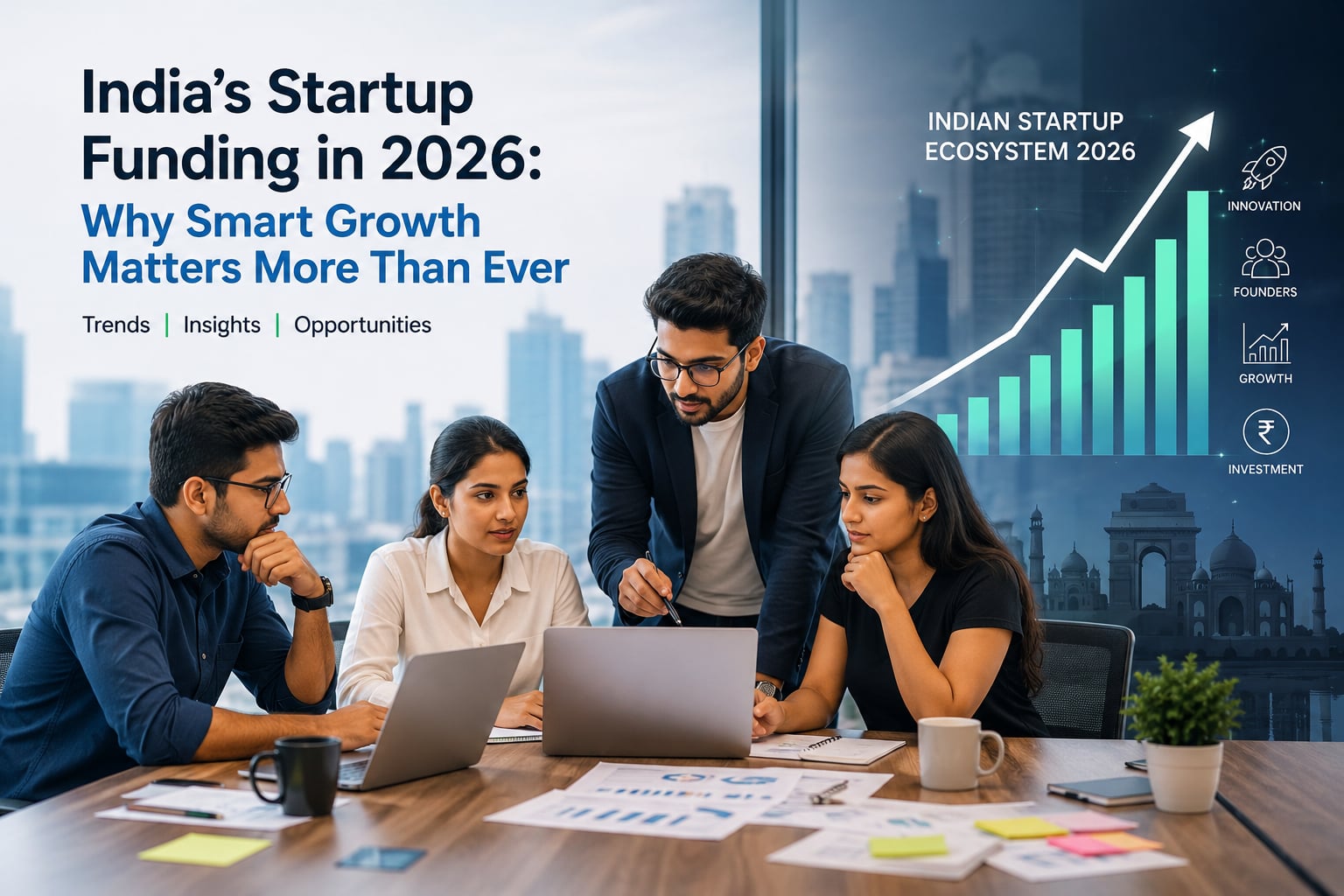
India remains one of the world's major startup markets, but the funding environment in 2026 is becoming increasingly selective. Recent GlobalData figures show that the number of venture-capital deals announced in India fell 13% during January–July 2026, while the total value of those deals increased by only 5% year over year.
That combination tells an important story.
The startup ecosystem is still attracting investment, but investors appear to be placing greater emphasis on where their money goes rather than simply increasing the number of investments.
For entrepreneurs, this could signal a broader shift in how startups need to build, grow and raise capital.
The Startup Funding Game Is Becoming More Selective
For several years, startup discussions often focused on fundraising milestones: how much a company raised, how quickly it grew and how large its valuation became.
That environment encouraged ambitious expansion.
But today's market increasingly rewards something different: evidence that the business actually works.
Investors want to understand whether a company can acquire customers efficiently, retain them, generate revenue and eventually produce sustainable returns.
This doesn't mean startups need to become profitable immediately.
It means founders need a credible path toward building a valuable business.
The difference is important.
A startup can have millions of users and still struggle financially. Another company with a much smaller customer base can have stronger economics and a clearer path to profitability.
In a more selective funding environment, those fundamentals can matter considerably.
More Capital Doesn't Automatically Mean Easier Fundraising
There is another side to India's funding story.
India-focused venture funds raised or launched more than $3.2 billion during the first half of 2026, according to Moneycontrol, with AI emerging as a major investment theme. Another $1.3 billion was reportedly being raised across additional funds at the time.
So the picture is not simply that investors have stopped putting money into India.
Capital is still available.
The challenge is that not every startup will receive the same level of attention.
This creates a more competitive environment for founders.
Instead of asking only:
“How much funding can we raise?”
Entrepreneurs increasingly need to ask:
“What have we built that makes investors want to fund us?”
The Rise of the Efficient Startup
One of the biggest opportunities created by this environment is the ability to build companies with smaller teams and lower operating costs.
Technology is changing what a small business can accomplish.
AI tools can help with customer support, research, content creation, software development, data analysis and many other repetitive activities. Automation can reduce manual processes and allow employees to spend more time on higher-value work.
For startups, this can have a direct financial impact.
If a company can achieve the same output with fewer resources, it can potentially extend its runway and reduce its dependence on external funding.
That does not mean technology replaces people.
Instead, it changes how people work.
A small team equipped with the right technology can potentially compete with much larger organizations in specific markets.
AI Is Becoming Part of the Business Strategy
AI is also changing the types of businesses investors are interested in.
India-focused VC fundraising in 2026 has shown strong interest in AI, while broader Indian venture activity is increasingly focused on areas including AI, deeptech, climate, space and industrial technology.
But there is an important distinction between using AI and building an AI business.
A company doesn't necessarily need to develop its own foundation model to benefit from artificial intelligence.
A traditional business can use AI to improve its operations.
A SaaS company can use AI to make its product more useful.
A service company can automate repetitive processes.
A startup can use AI to reduce the amount of time required to research, develop and launch new products.
The competitive advantage may therefore come not from simply saying “we use AI,” but from using it better than competitors.
The New Question: How Efficiently Can You Grow?
For founders, growth remains important.
But growth without economics can become expensive.
Consider two hypothetical startups.
Startup A spends heavily on advertising and promotions to acquire customers. Its user numbers increase rapidly, but many customers leave after a few months.
Startup B grows more slowly but has strong customer retention, recurring revenue and controlled acquisition costs.
Startup A may look more impressive at first.
Startup B may ultimately represent the stronger business.
This is why metrics such as customer acquisition cost, lifetime value, retention, recurring revenue and gross margin matter.
They help answer a fundamental question:
Is the company growing because it has found a valuable product—or because it is spending heavily to manufacture growth?
What Should Founders Focus on Now?
The current environment provides several practical lessons for entrepreneurs.
1. Solve a Real Problem
A sophisticated product is not automatically a valuable product.
Start by understanding what customers actually struggle with and whether they are willing to pay for a solution.
2. Build Before You Scale
Founders should avoid spending heavily before they have evidence of demand.
An MVP can help test the basic concept before significant resources are committed.
3. Watch Your Unit Economics
Revenue alone doesn't tell the complete story.
Founders should understand how much it costs to acquire customers, how much those customers generate and how long they remain with the business.
4. Use Technology Strategically
AI and automation can help startups operate more efficiently, but technology should solve a business problem rather than exist simply as a marketing label.
5. Build a Sustainable Revenue Model
Recurring revenue can provide greater predictability for software and subscription businesses.
For other companies, repeat purchases, long-term contracts or diversified revenue streams can provide similar stability.
6. Treat Funding as Fuel
Investment should help a strong business grow faster.
It shouldn't be the only thing keeping the business alive.
Does This Mean Bootstrapping Is Becoming More Important?
For some entrepreneurs, yes.
Bootstrapping can allow founders to maintain greater control while learning how customers respond to their product.
It also encourages financial discipline.
However, bootstrapping isn't suitable for every industry.
A semiconductor company, biotechnology startup or deep-tech business may require substantial capital before reaching commercial scale.
For software, digital products and many service businesses, however, starting lean can be much more practical.
The right approach depends on the business model.
The larger lesson is simply this:
Don't raise money before understanding what you need it for.
India's Startup Ecosystem Is Entering a More Mature Phase
The current funding environment may actually represent a sign of maturity.
A mature startup ecosystem isn't one where every company can raise money easily.
It is one where capital is increasingly directed toward businesses that demonstrate strong potential.
India's venture market continues to attract significant institutional capital, while investors are showing greater interest in AI, deeptech and other technology-driven sectors. At the same time, GlobalData's latest numbers show that deal activity has become more selective.
These trends can coexist.
There can be plenty of capital in the ecosystem while individual startups still struggle to raise it.
That is because capital availability and capital accessibility are not the same thing.
What This Means for the Next Generation of Entrepreneurs
The next generation of successful Indian startups may not necessarily be the companies that raise the biggest rounds.
They may be the companies that understand their customers better, operate efficiently and build sustainable advantages.
That could mean:
- Smaller teams.
- Better technology.
- Stronger customer relationships.
- More disciplined spending.
- Clearer revenue models.
And eventually, businesses that can grow because customers genuinely want what they offer.
The funding environment may change again in the future. Markets always do.
But one principle is unlikely to change:
A startup becomes valuable by creating value for its customers—not simply by raising money.
AnantaHQ Perspective
At AnantaHQ, we believe technology should make businesses more capable, not simply more complicated.
AI and automation are creating opportunities for businesses to reduce repetitive work, improve productivity and build products with fewer resources.
For entrepreneurs, this means the barrier to building a technology-driven business is changing.
The opportunity isn't only to raise more capital.
It is to build smarter with the resources you already have.
As India's startup ecosystem continues to evolve, the businesses that combine strong customer value, efficient operations and smart use of technology may be the ones best positioned for the next phase of growth.
The future of entrepreneurship may belong not to the companies that spend the most, but to the companies that create the most value from what they have.
Discussion (0)
No comments yet. Be the first to join the conversation!