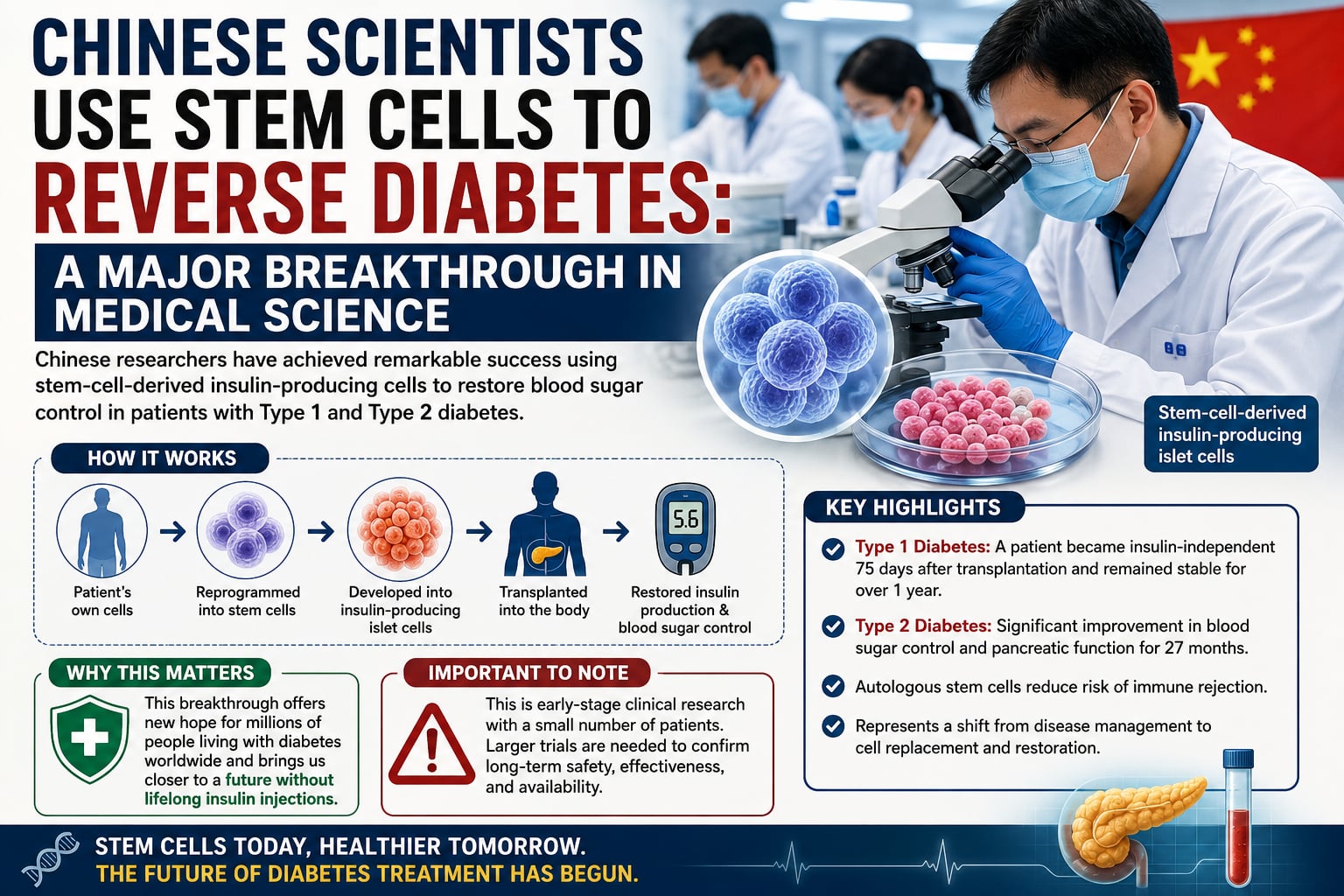
Chinese Scientists Use Stem Cells to Reverse Diabetes: How Close Are We to a Cure?
For decades, diabetes has been considered a chronic disease that can be managed but not easily reversed. However, recent research from China has created new hope by using stem-cell-derived insulin-producing cells to restore the body's ability to control blood sugar.
The breakthrough is particularly interesting because scientists have reported promising results in both Type 1 and Type 2 diabetes— although the research is still at an early clinical stage.
What Are Stem Cells?
Stem cells are special cells that can develop into different types of cells in the human body. Scientists can reprogram certain cells into pluripotent stem cells, which can then be developed into insulin-producing pancreatic islet cells.
The basic idea is simple:
Patient's cells → Stem cells → Insulin-producing islet cells → Transplantation → Insulin productionThis approach is part of a broader field called regenerative medicine, where scientists try to replace damaged or missing cells instead of treating only the symptoms.
Type 1 Diabetes: A Major Breakthrough
In 2024, a Chinese research team reported a remarkable result in a patient with Type 1 diabetes.
The scientists used the patient's cells to create chemically induced pluripotent stem cells (CiPSCs) and then developed them into insulin-producing islet cells. These cells were transplanted into the patient's abdominal region.
The result was remarkable.The patient became independent of insulin injections 75 days after transplantation. During the one-year follow-up, her blood-glucose control remained stable, with glycated hemoglobin around the non-diabetic range.
This was significant because Type 1 diabetes occurs when the immune system destroys the body's insulin-producing beta cells.
However, there is an important limitation: this was a first-in-human study involving one patient, so it does not yet prove that the treatment will work safely and effectively for everyone.
What About Type 2 Diabetes?
Scientists have also explored stem-cell-derived islet tissue for Type 2 diabetes.
In a 2024 study published in Cell Discovery, researchers reported treating a patient with Type 2 diabetes who had impaired pancreatic islet function. The researchers created personalized islet tissue from stem cells and transplanted it into the patient.
The study reported significant improvements in glucose control and pancreatic islet function over a 27-month observation period. The researchers described it as the first reported human tissue-replacement approach using autologous stem-cell-derived islets for this type of Type 2 diabetes.
But Type 2 diabetes is more complicated than simply losing insulin-producing cells. Insulin resistance, lifestyle factors, genetics and other metabolic problems can all contribute to the disease.
Therefore, replacing insulin-producing cells may not eliminate every underlying cause of Type 2 diabetes.
Why Is This Technology Important?
Traditional diabetes treatment mainly focuses on controlling blood glucose through insulin, medicines, diet, exercise and monitoring.
Stem-cell therapy takes a different approach.
Instead of simply supplying insulin from outside the body, scientists are trying to restore the body's own insulin-producing system.
If this technology becomes safe, scalable and affordable, it could potentially reduce the need for lifelong insulin injections for some patients.
Is Diabetes Already Cured?
No — not yet.This distinction is extremely important.
The Chinese studies are scientifically exciting, but they involve early-stage clinical research and a very small number of patients. Larger clinical trials are needed to determine:
- How safe the treatment is over many years
- Whether transplanted cells continue producing insulin permanently
- Whether the immune system attacks the new cells
- Whether the treatment works in large numbers of patients
- Whether the treatment can be manufactured at reasonable cost
For Type 1 diabetes in particular, the autoimmune attack remains an important challenge. Even if new insulin-producing cells are successfully transplanted, the patient's immune system may potentially attack those cells again.
The Future of Diabetes Treatment
The research represents a major shift in diabetes research—from managing the disease toward potentially replacing damaged cells.
Scientists are now investigating better stem-cell production methods, improved transplantation techniques and ways to protect transplanted cells from the immune system.
In March 2026, researchers in Shanghai also reported an exploratory clinical study involving six patients using stem-cell-derived regenerative islets for Type 1 diabetes, showing that research in this area is continuing to expand.
The future may not be a single "miracle cure." Instead, diabetes treatment could evolve toward personalized regenerative therapies that restore insulin-producing cells and address the underlying biology of the disease.
Conclusion
Chinese scientists have produced some of the most exciting recent evidence that stem-cell-derived islet transplantation could potentially restore insulin production in people with diabetes.
The results in Type 1 diabetes are especially remarkable, with one patient becoming insulin-independent after transplantation. Research has also produced encouraging results in a patient with Type 2 diabetes and impaired pancreatic function.
But calling diabetes completely cured today would be premature.
The real breakthrough is that scientists have demonstrated something that was once extremely difficult: human cells can be reprogrammed, turned into insulin-producing tissue, transplanted into a patient, and used to restore glucose regulation.
If larger clinical trials confirm these results, stem-cell therapy could become one of the most important developments in diabetes treatment in the coming years.
Discussion (0)
No comments yet. Be the first to join the conversation!